menu

Franklin, MI

This is a small community in a single neighborhood. As throughout the site, some neighborhood-level data are reserved for subscribers.


Overview


Franklin is a very small village located in the state of Michigan. With a population of 3,160 people and just one neighborhood, Franklin is the 267th largest community in Michigan.

Franklin home prices are not only among the most expensive in Michigan, but Franklin real estate also consistently ranks among the most expensive in America.

Occupations and Workforce

Franklin is a decidedly white-collar village, with fully 96.05% of the workforce employed in white-collar jobs, well above the national average. Overall, Franklin is a village of professionals, managers, and sales and office workers. There are especially a lot of people living in Franklin who work in healthcare (17.39%), management occupations (15.54%), and sales jobs (11.27%).

Also of interest is that Franklin has more people living here who work in computers and math than 95% of the places in the US.

A relatively large number of people in Franklin telecommute to their jobs. Overall, about 22.79% of the workforce works from home. While this may seem like a small number, as a fraction of the total workforce it ranks among the highest in the country. These workers are often telecommuters who work in knowledge-based, white-collar professions. For example, Silicon Valley has large numbers of people who telecommute. Other at-home workers may be self-employed people who operate small businesses out of their homes.

Setting & Lifestyle

In addition, Franklin is home to many people who could be described as "urban sophisticates". Urban sophisticates are people who are both educated and wealthy, and thus tend to be older, richer, and more established than young professionals. "Urban sophisticates" is not just about being educated and well-off financially: it is a point of view and state of mind, one that you might call 'urbaneness'. But such people can and do regularly live in small towns, suburbs and rural areas, as well as in big cities. They read, support the arts and high-end shops, and love travel.

Because of many things, Franklin is a great place for families with children to consider. First of all, many other families with children live here, making Franklin a place where both parents and children are more likely to develop social ties with other families, as well as find family-oriented services and community. The village’s good public school district and large population of college-educated adults provide an environment conducive to academic values. With regard to real estate, Franklin has a high rate of owner-occupied single family homes, which tends to reflect stability in the local community. Finally, Franklin’s overall crime rate is lower than average for the country.

Demographics

Do you like to read, write and learn? If you move to Franklin, you'll likely find that many of your neighbors like to as well. Franklin is one of the more educated communities in America, with a full 80.23% of its adults having a college degree or even advanced degree, compared to a national average across all communities of 21.84%.

The per capita income in Franklin in 2022 was $125,797, which is wealthy relative to Michigan and the nation. This equates to an annual income of $503,188 for a family of four.

Franklin is a very ethnically-diverse village. The people who call Franklin home describe themselves as belonging to a variety of racial and ethnic groups. The greatest number of Franklin residents report their race to be White, followed by Black or African-American. Important ancestries of people in Franklin include German, Polish, English, Irish, and Italian.

The most common language spoken in Franklin is English. Other important languages spoken here include Arabic and Spanish.

Notable & Unique Neighborhood Characteristics

The way a neighborhood looks and feels when you walk or drive around it, from its setting, its buildings, and its flavor, can make all the difference. This neighborhood has some really cool things about the way it looks and feels as revealed by NeighborhoodScout's exclusive research. This might include anything from the housing stock to the types of households living here to how people get around.

People

If you're a regular supporter of the arts and enjoy outings to the theatre, weekend boutique-ing, or even a finely aged wine with dinner, than you're in good company with the people of the neighborhood. This neighborhood is uniquely immersed with more "urban sophisticates" than 98.8% of neighborhoods across the country. The people here truly stand out as a class among their own. They are an exclusive community characterized by refined tastes, cultural inclinations, and the means to live well. Urban sophisticates live a big city lifestyle, whether or not they live in or near a big city. They are educated executives or managers by week, and serial patrons of the arts by weekend. If this lifestyle pertains to you, than you'll certainly feel right at home in the neighborhood. In addition to being an excellent choice for urban sophisticates, this neighborhood is also a very good choice for highly educated executives, active retirees and families with school-aged children.

In addition, if you come to know the people here, you will recognize that you're in the company of one of the wealthiest communities in the nation. In fact, a mere 1.3% of America's neighborhoods are wealthier than the neighborhood. Real estate here is exceedingly well-maintained, and similarly, tends to maintain its value over time. The cars driven are mostly luxury brands like Mercedes, Audi, BMW, and Lexus. If the public schools aren't up to snuff, the residents of this neighborhood preferentially send their children to private preparatory schools. Vacation to Disney? Yes, but equally popular are summers in Europe.

Also, some neighborhoods have residents that are more educated than others. But in this neighborhood there is a dramatic difference. NeighborhoodScout's exclusive analysis reveals that 42.3% of the adults here have earned a Masters degree, medical degree, Ph.D. or law degree. This is a higher rate of people with a graduate degree than is found in 97.5% of U.S. neighborhoods, where the average American neighborhood has 14.1% of its adults with a graduate degree. If you are highly educated, you may have much in common with many of your neighbors here.

Real Estate

Owner-occupied real estate dominates the neighborhood. In fact, according to NeighborhoodScout research, the percentage of residential real estate occupied by its owner is higher here than in 98.3% of neighborhoods in America.

In addition, one way that the neighborhood really stands out, is that it has more large 4, 5, or additional bedroom homes and real estate than 95.6% of the neighborhoods in America. When you walk or drive around this neighborhood, you'll instantly notice the size of the homes here which definitely makes a strong visual statement.

Occupations

Executives, managers and professionals make up 72.3% of the workforce in the neighborhood which, according to NeighborhoodScout's exclusive analysis, is a higher proportion of such high-level people than is found in 96.0% of the neighborhoods in America. For this reason, this neighborhood really stands out as unique.

Diversity

Did you know that the neighborhood has more Arab and Lebanese ancestry people living in it than nearly any neighborhood in America? It's true! In fact, 6.9% of this neighborhood's residents have Arab ancestry and 2.3% have Lebanese ancestry.

is also pretty special linguistically. Significantly, 5.8% of its residents five years old and above primarily speak Arabic at home. While this may seem like a small percentage, it is higher than 98.7% of the neighborhoods in America.

The Neighbors

How wealthy a neighborhood is, from very wealthy, to middle income, to low income is very formative with regard to the personality and character of a neighborhood. Equally important is the rate of people, particularly children, who live below the federal poverty line. In some wealthy gated communities, the areas immediately surrounding can have high rates of childhood poverty, which indicates other social issues. NeighborhoodScout's analysis reveals both aspects of income and poverty for this neighborhood.

The neighbors in the neighborhood in Franklin are wealthy, making it among the 15% highest income neighborhoods in America. NeighborhoodScout's exclusive analysis reveals that this neighborhood has a higher income than 98.7% of the neighborhoods in America. In addition, 2.4% of the children seventeen and under living in this neighborhood are living below the federal poverty line, which is a lower rate of childhood poverty than is found in 73.2% of America's neighborhoods.

The old saying "you are what you eat" is true. But it is also true that you are what you do for a living. The types of occupations your neighbors have shape their character, and together as a group, their collective occupations shape the culture of a place.

In the neighborhood, 72.3% of the working population is employed in executive, management, and professional occupations. The second most important occupational group in this neighborhood is sales and service jobs, from major sales accounts, to working in fast food restaurants, with 15.7% of the residents employed. Other residents here are employed in clerical, assistant, and tech support occupations (8.5%), and 3.5% in manufacturing and laborer occupations.

Languages

The languages spoken by people in this neighborhood are diverse. These are tabulated as the languages people preferentially speak when they are at home with their families. The most common language spoken in the neighborhood is English, spoken by 85.2% of households. Other important languages spoken here include Arabic and German/Yiddish.

Ethnicity / Ancestry

Boston's Beacon Hill blue-blood streets, Brooklyn's Orthodox Jewish enclaves, Los Angeles' Persian neighborhoods. Each has its own culture derived primarily from the ancestries and culture of the residents who call these neighborhoods home. Likewise, each neighborhood in America has its own culture – some more unique than others – based on lifestyle, occupations, the types of households – and importantly – on the ethnicities and ancestries of the people who live in the neighborhood. Understanding where people came from, who their grandparents or great-grandparents were, can help you understand how a neighborhood is today.

In the neighborhood in Franklin, MI, residents most commonly identify their ethnicity or ancestry as German (12.0%). There are also a number of people of Polish ancestry (9.6%), and residents who report Irish roots (7.3%), and some of the residents are also of English ancestry (7.2%), along with some Arab ancestry residents (6.9%), among others. In addition, 13.3% of the residents of this neighborhood were born in another country.

Getting to Work

How you get to work – car, bus, train or other means – and how much of your day it takes to do so is a large quality of life and financial issue. Especially with gasoline prices rising and expected to continue doing so, the length and means of one's commute can be a financial burden. Some neighborhoods are physically located so that many residents have to drive in their own car, others are set up so many walk to work, or can take a train, bus, or bike. The greatest number of commuters in neighborhood spend between 15 and 30 minutes commuting one-way to work (43.9% of working residents), which is shorter than the time spent commuting to work for most Americans.

Here most residents (69.5%) drive alone in a private automobile to get to work. In a neighborhood like this, as in most of the nation, many residents find owning a car useful for getting to work.


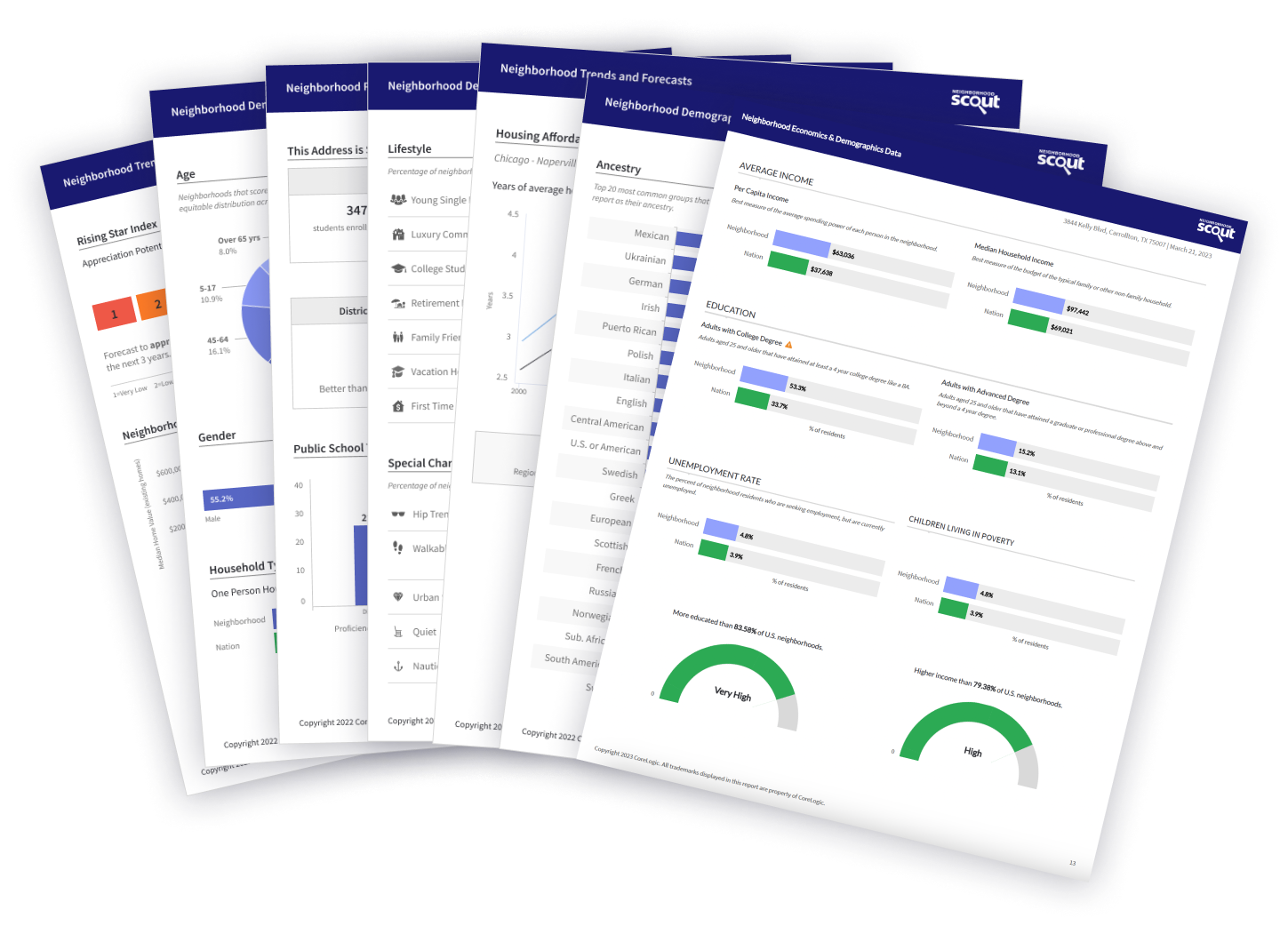
Real Estate includes:
Average Home Values
Rental Market
Housing Market Details
Neighborhood Setting
Economics & Demographics include:
Lifestyle & Special Character
Household Types
Commute To Work
Migration & Mobility
Race & Ethnic Diversity
Employment Industries & Occupations
Income & Unemployment Rate
Higher Education Attainment
Crime includes:
Neighborhood Crime Index
Crimes Per Square Mile
Property Crime Comparison
Violent Crime Comparison
Schools include:
School Ratings
Schools In District
Public School Test Scores
School District Enrollment
Educational Expenditures

comparable neighborhoods nearby