Chadwicks is a very small town located in the state of New York. With a population of 1,291 people and just one neighborhood, Chadwicks is the 707th largest community in New York. Much of the housing stock in Chadwicks was built prior to World War II, making it one of the older and more historic towns in the country.
Chadwicks is a decidedly white-collar town, with fully 100.00% of the workforce employed in white-collar jobs, well above the national average. Overall, Chadwicks is a town of professionals, service providers, and managers. There are especially a lot of people living in Chadwicks who work in management occupations (17.18%), teaching (13.74%), and maintenance occupations (12.79%).
Also of interest is that Chadwicks has more people living here who work in computers and math than 95% of the places in the US.
In addition, Chadwicks is home to many people who could be described as "urban sophisticates". Urban sophisticates are people who are both educated and wealthy, and thus tend to be older, richer, and more established than young professionals. "Urban sophisticates" is not just about being educated and well-off financially: it is a point of view and state of mind, one that you might call 'urbaneness'. But such people can and do regularly live in small towns, suburbs and rural areas, as well as in big cities. They read, support the arts and high-end shops, and love travel.
One of the benefits of Chadwicks is that there is very little traffic. The average commute to work is 14.97 minutes, which is substantially less than the national average. Not only does this mean that the drive to work is less aggravating, but noise and pollution levels are lower as a result.
Chadwicks is a small town, and as such doesn't have a public transit system that people use to get to and from their jobs every day.
The percentage of people in Chadwicks who are college-educated is somewhat higher than the average US community of 21.84%: 27.58% of adults in Chadwicks have at least a bachelor's degree.
The per capita income in Chadwicks in 2022 was $44,163, which is middle income relative to New York, and upper middle income relative to the rest of the US. This equates to an annual income of $176,652 for a family of four. However, Chadwicks contains both very wealthy and poor people as well.
The people who call Chadwicks home describe themselves as belonging to a variety of racial and ethnic groups. The greatest number of Chadwicks residents report their race to be White. Important ancestries of people in Chadwicks include Italian, Polish, German, Irish, and Norwegian.
The most common language spoken in Chadwicks is English. Other important languages spoken here include Langs. of India and Russian.
When you see a neighborhood for the first time, the most important thing is often the way it looks, like its homes and its setting. Some places look the same, but they only reveal their true character after living in them for a while because they contain a unique mix of occupational or cultural groups. This neighborhood is very unique in some important ways, according to NeighborhoodScout's exclusive exploration and analysis.
Of note is NeighborhoodScout's research finding that the neighborhood has some of the lowest rates of children living in poverty of any neighborhood in the United States. In a nation where approximately 1 in 4 children are living in poverty, the community truly stands out from the rest in this regard.
In addition, the neighborhood is considered a solid choice for executive lifestyles. NeighborhoodScout's analysis ranks it as better than 92.5% of New York neighborhoods for executive living, based on the wealthy, educated professionals, executives, and managers who choose to reside here, the spacious homes that are prominent features of the real estate in the neighborhood, and the high real estate appreciation rates found here relative to other neighborhoods in the state. In addition to being an excellent choice for highly educated executives, this neighborhood is also a very good choice for urban sophisticates.
Did you know that the neighborhood has more Ukrainian and Italian ancestry people living in it than nearly any neighborhood in America? It's true! In fact, 6.7% of this neighborhood's residents have Ukrainian ancestry and 32.8% have Italian ancestry.
There are two complementary measures for understanding the income of a neighborhood's residents: the average and the extremes. While a neighborhood may be relatively wealthy overall, it is equally important to understand the rate of people - particularly children - who are living at or below the federal poverty line, which is extremely low income. Some neighborhoods with a lower average income may actually have a lower childhood poverty rate than another with a higher average income, and this helps us understand the conditions and character of a neighborhood.
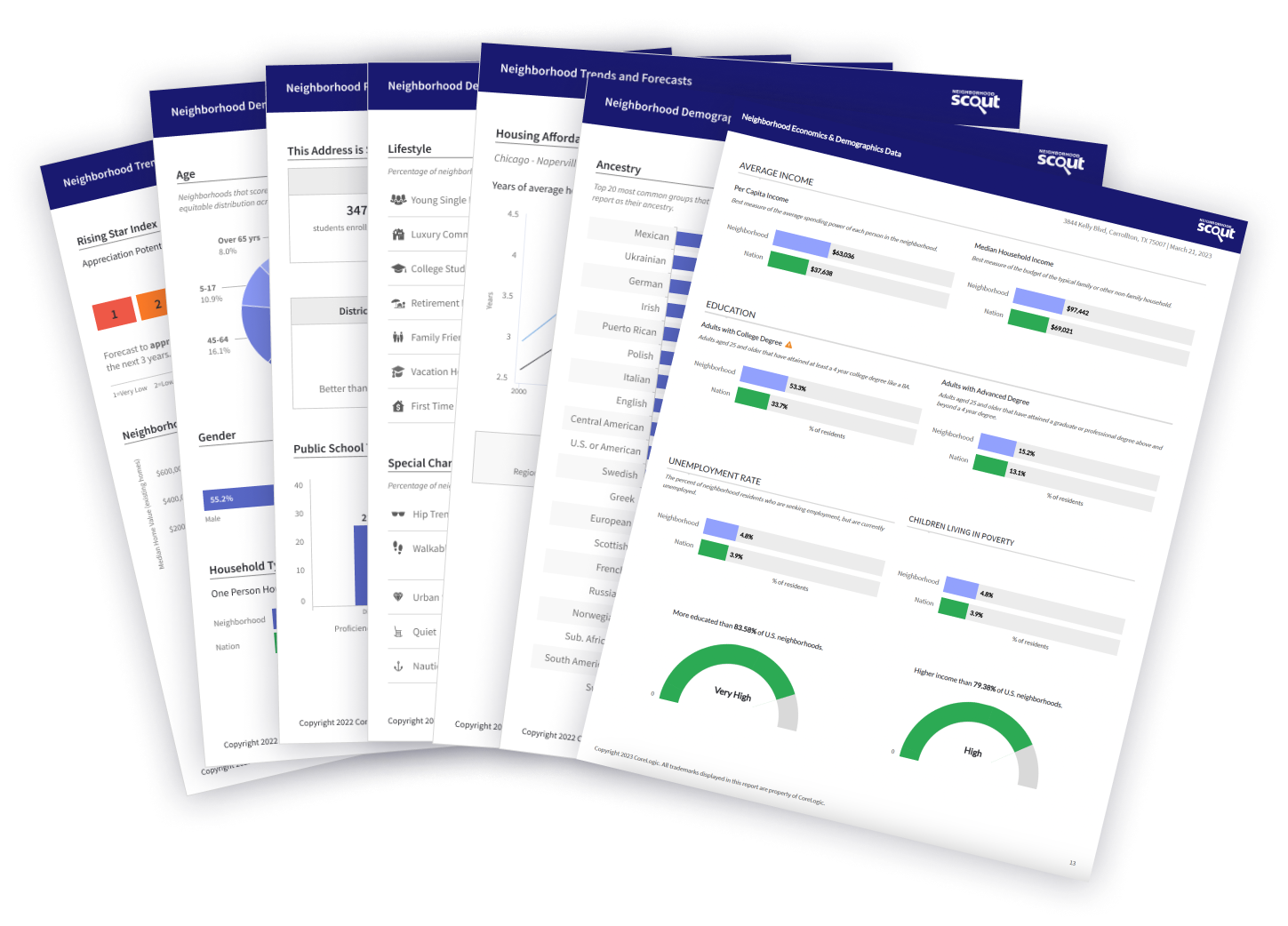
The neighbors in the neighborhood in Chadwicks are upper-middle income, making it an above average income neighborhood. NeighborhoodScout's exclusive analysis reveals that this neighborhood has a higher income than 82.3% of the neighborhoods in America. In addition, 0.0% of the children seventeen and under living in this neighborhood are living below the federal poverty line, which is a lower rate of childhood poverty than is found in 100.0% of America's neighborhoods.
The old saying "you are what you eat" is true. But it is also true that you are what you do for a living. The types of occupations your neighbors have shape their character, and together as a group, their collective occupations shape the culture of a place.
In the neighborhood, 60.8% of the working population is employed in executive, management, and professional occupations. The second most important occupational group in this neighborhood is sales and service jobs, from major sales accounts, to working in fast food restaurants, with 21.7% of the residents employed. Other residents here are employed in clerical, assistant, and tech support occupations (9.9%), and 7.6% in manufacturing and laborer occupations.
The most common language spoken in the neighborhood is English, spoken by 89.7% of households. Some people also speak Chinese (2.9%).
Boston's Beacon Hill blue-blood streets, Brooklyn's Orthodox Jewish enclaves, Los Angeles' Persian neighborhoods. Each has its own culture derived primarily from the ancestries and culture of the residents who call these neighborhoods home. Likewise, each neighborhood in America has its own culture – some more unique than others – based on lifestyle, occupations, the types of households – and importantly – on the ethnicities and ancestries of the people who live in the neighborhood. Understanding where people came from, who their grandparents or great-grandparents were, can help you understand how a neighborhood is today.
In the neighborhood in Chadwicks, NY, residents most commonly identify their ethnicity or ancestry as Italian (32.8%). There are also a number of people of German ancestry (18.2%), and residents who report Irish roots (15.5%), and some of the residents are also of English ancestry (8.5%), along with some Polish ancestry residents (7.7%), among others.
How you get to work – car, bus, train or other means – and how much of your day it takes to do so is a large quality of life and financial issue. Especially with gasoline prices rising and expected to continue doing so, the length and means of one's commute can be a financial burden. Some neighborhoods are physically located so that many residents have to drive in their own car, others are set up so many walk to work, or can take a train, bus, or bike. The greatest number of commuters in neighborhood spend under 15 minutes commuting one-way to work (46.4% of working residents), one of the shortest commutes across America.
Here most residents (81.6%) drive alone in a private automobile to get to work. In a neighborhood like this, as in most of the nation, many residents find owning a car useful for getting to work.